
Install
Run the installer. VolumeKeys appears in the menu bar. No Terminal and no complicated setup.
 VolumeKeys
Some audio interfaces and displays disable F10, F11 and F12. VolumeKeys brings them back for your chosen output. No extra window required.
45-second product tour
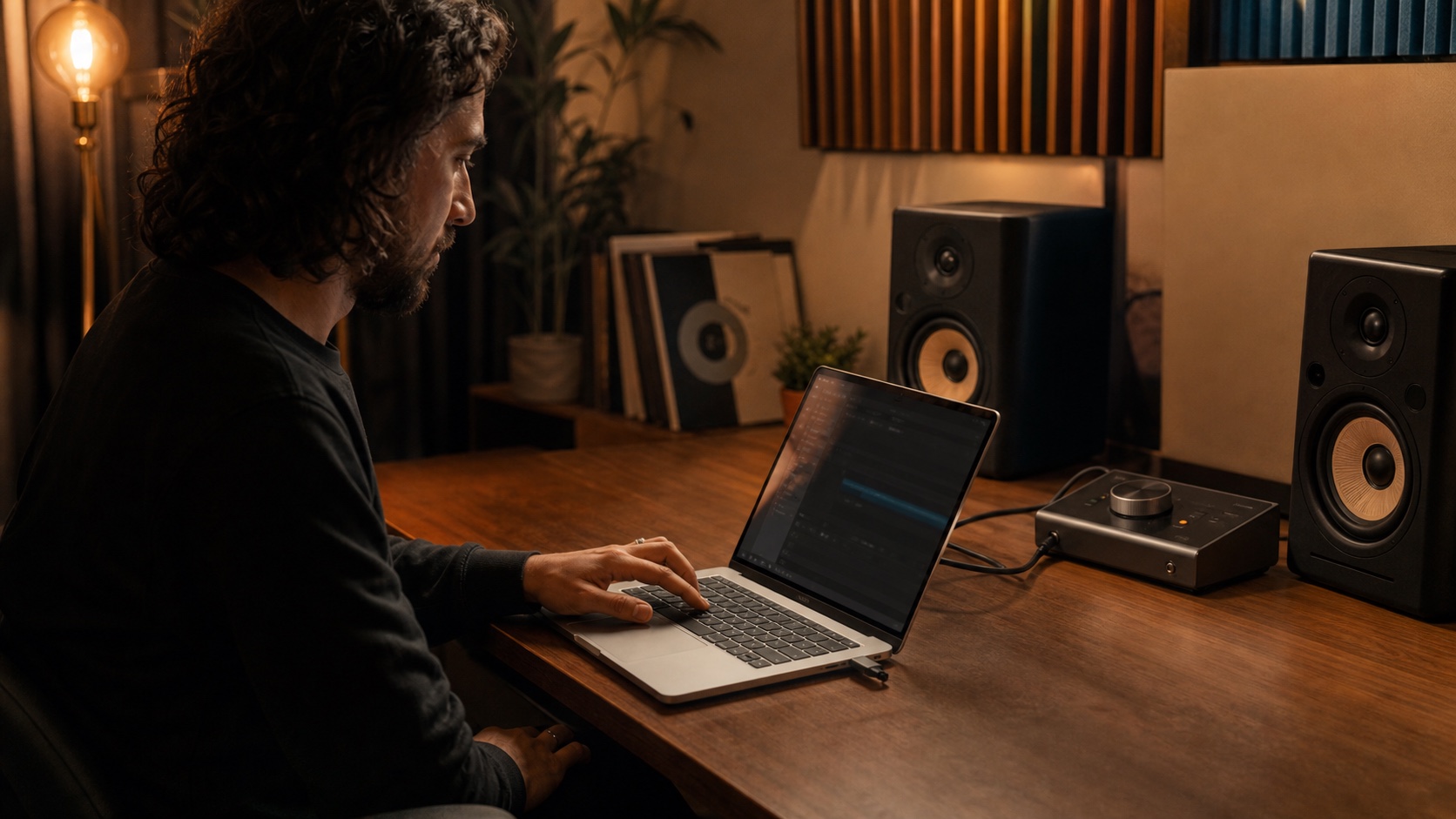
Watch VolumeKeys bring F10, F11 and F12 back, switch between available outputs and stay quietly in the menu bar.
How it works
Install VolumeKeys, choose your interface, and keep using your Mac the way you already do.
Run the installer. VolumeKeys appears in the menu bar. No Terminal and no complicated setup.
Choose your audio interface or display and the output you want to control. VolumeKeys remembers both.
Press F10, F11 or F12 to mute, turn down or turn up. That’s it.
More than volume keys
VolumeKeys keeps the controls simple and handles the important details in the background.
Digital monitor controller
Set and remember a separate volume for every output pair, level-match your monitors, then switch globally to compare the same track at a consistent listening level without repatching cables.
High-precision 32-bit floating-point volume processing designed for transparent monitor control.
Digital attenuation
VolumeKeys attenuates the routed Mac signal and is not designed to add gain above the source level. Set your interface or monitor control for the physical listening level you want.
Private by design
Your audio is processed locally and is not sent to our servers by VolumeKeys. The app contains no ads or app-usage analytics.
Controlled changes
VolumeKeys fades device and output-pair changes through silence, then fades into the volume saved for the destination pair. Match different monitor pairs once and compare them at a consistent listening level without a second jump after the switch.
Hear both channels together to spot phase and balance problems.
Focus isolates everything below 150 Hz for precise low-end decisions. Night focuses its processing where bass becomes physical. A purpose-built low-frequency DSP algorithm reduces the deep energy that makes rooms and walls vibrate while keeping the musical body of the mix intact. You hear a full, balanced sound at night, while less bass travels next door.
Follows the active hardware/DAW buffer without a second competing setting.
If the selected interface or display disconnects, VolumeKeys automatically returns system playback to the current macOS default output.
Recording
Select the physical interface in your DAW for recording. VolumeKeys can control normal Mac audio at the same time.
Global shortcuts
From anywhere on your Mac: switch monitor pairs, toggle VolumeKeys, check mono and audition both bass modes.
Only available output pairs get a shortcut. Each global shortcut is registered independently, so a conflict on one shortcut does not disable the others.
7 days free.
Download VolumeKeys, set it up in minutes and explore the complete app on your own Mac for 7 days. No payment details are required, and you decide whether to buy.
7 days free. Just download. No payment details required.
Questions?
Try the complete app free for 7 days on your own Mac. Then decide in your own time.
Many audio interfaces and digital display outputs do not give macOS a settable volume control, so F10-F12 stop changing the level. VolumeKeys creates a software-controlled route for compatible Core Audio outputs and brings the keys back.
VolumeKeys attenuates the routed Mac signal and is not designed to add gain above the source level. Actual loudness still depends on the source audio, interface, amplifier, headphones and speakers.
Bass Focus uses a fourth-order Linkwitz–Riley low-pass (24 dB per octave) set to 150 Hz. Two cascaded Butterworth stages create a smooth, monotonic curve with −6 dB at the labelled cutoff, while left and right are filtered independently so the low end stays stereo. Its coefficients are calculated for the active sample rate, and a 30 ms crossfade with fixed safety headroom makes switching clean without look-ahead or added buffering latency. You hear kick, bass and low-frequency buildup in isolation, not through a crude one-knob EQ.
Bass Night targets long-wavelength low frequencies, which typical walls and floors attenuate less effectively and can transmit through a building’s structure. A second-order Butterworth high-pass at 60 Hz attenuates deep sub-bass; then a −6 dB low shelf at 200 Hz, based on Robert Bristow-Johnson’s biquad design, progressively reduces the remaining low end while keeping the mids and highs intact. The stereo, sample-rate-aware cascade runs without look-ahead or extra buffering and blends over 30 ms, so it sounds balanced instead of abruptly thin. It reduces low-frequency energy entering the room; listening level and the building still determine how much reaches your neighbours.
The minimum system version is macOS 14.2. VolumeKeys supports Apple silicon and Intel Macs. Every feature is included free for 7 days, so you can experience the complete app on your own Mac before you decide.
VolumeKeys supports compatible Core Audio outputs, including USB and Thunderbolt interfaces as well as HDMI or DisplayPort displays that appear as standard stereo outputs. Every feature is included free for 7 days, so you can experience the complete app with your preferred output before you decide.
Not for normal audio use. Internet is needed to download, buy and activate VolumeKeys. After successful activation, a paid license is designed for normal offline use, subject to its local license state and technical requirements.
VolumeKeys is a one-time purchase with no subscription. Taxes are included in the price.